

With the financial year 2024-25 underway, understanding the nuances of the Income Tax Act 2025 becomes vital for every taxpayer. Filing income tax returns ensures compliance with legal requirements and allows you to optimize your financial planning. As the government frequently revises income tax provisions, exemptions, and deductions, staying informed about these changes can significantly affect your tax liability.
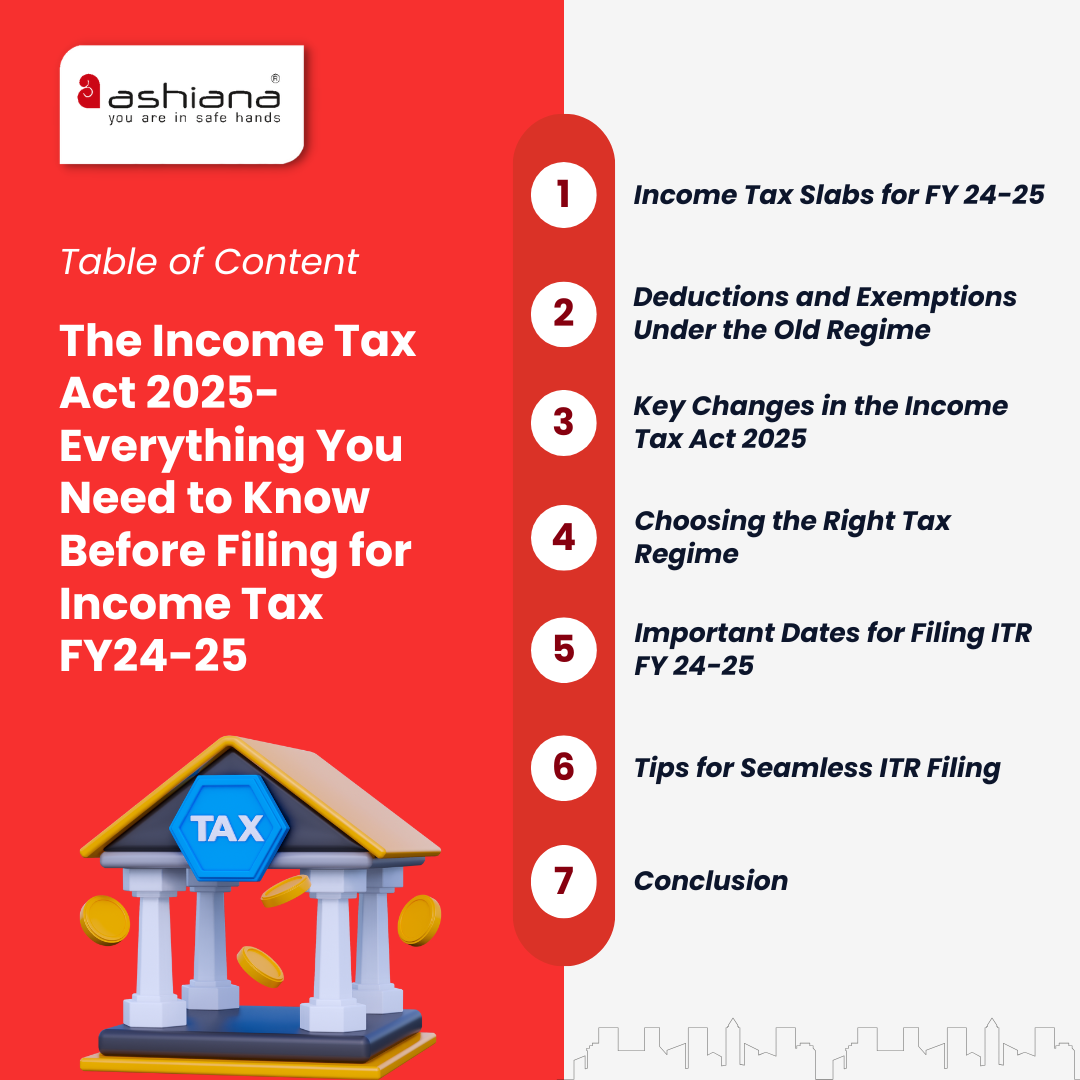
Here’s a detailed guide to help you navigate the process of filing your income tax returns for FY 24-25 efficiently.
The foundation of income tax calculations lies in tax slabs, which specify the rate of taxation based on an individual’s income. For FY 24-25, the government offers two regimes for taxpayers to choose from:
2. New Tax Regime: Provides lower tax rates but removes most exemptions and deductions.
Let’s take a closer look at the slabs under both regimes.
| Income Range (₹) | Old Tax Regime | New Tax Regime |
| Up to ₹2,50,000 | Nil | Nil |
| ₹2,50,001 to ₹3,00,000 | 5% | Nil |
| ₹3,00,001 to ₹5,00,000 | 5% | 5% |
| ₹5,00,001 to ₹6,00,000 | 20% | 5% |
| ₹6,00,001 to ₹9,00,000 | 20% | 10% |
| ₹9,00,001 to ₹10,00,000 | 20% | 15% |
| ₹10,00,001 to ₹12,00,000 | 30% | 15% |
| ₹12,00,001 to ₹15,00,000 | 30% | 20% |
| Above ₹15,00,000 | 30% | 30% |
This comparison simplifies choosing the right regime based on your income and financial planning preferences.
The old tax regime remains popular among taxpayers who invest strategically to claim deductions. Here’s a list of the most common deductions:
These deductions can substantially reduce taxable income, making the old regime attractive for taxpayers with significant eligible expenses.
Also read: Income Tax Deductions List – 80C & 80D – FY 2023-24
The government has introduced several updates for FY 24-25 that taxpayers need to be aware of:
Salaried individuals and pensioners can now claim a ₹50,000 standard deduction under the new tax regime.
Under the new regime, Section 87A now provides a rebate for individuals with taxable income up to ₹7,00,000. This makes the new regime particularly beneficial for middle-income earners.
Pre-filled Income Tax Return (ITR) forms are available to make the filing process more efficient. These forms include information on salary, TDS, and other financial data, reducing manual effort and errors.
Also read: 6 Ways to Save on Your Income Tax in 2024-25
Selecting the appropriate tax regime depends on your financial situation, including income sources, investment habits, and eligible deductions.
Let’s consider an individual earning ₹12,00,000 annually:
Taxpayers should calculate their tax liability under both regimes before making a decision.
Mark your calendar with these key dates to avoid penalties:
Late filing attracts penalties under Section 234F, ranging from ₹1,000 to ₹5,000, depending on the delay.
The Income Tax Act 2025 brings both opportunities and responsibilities for taxpayers. By understanding the new and old tax regimes, evaluating changes, and filing your returns on time, you can effectively manage your finances and comply with tax laws. Choose the regime that aligns with your financial goals, plan investments wisely, and leverage deductions to minimize your tax liability.
Join 1000+ of fellow readers. Get expert real estate knowledge straight to your inbox absolutely free. Just enter your email address below.


Leave a Reply