

Understanding investment growth is critical in today’s data-driven financial landscape. Whether you’re an investor, analyst, or business owner, a CAGR Calculator can simplify complex growth analysis and provide actionable insights. But what exactly is CAGR, and why does it matter so much in 2026? Let’s break it down in a clear, practical way.
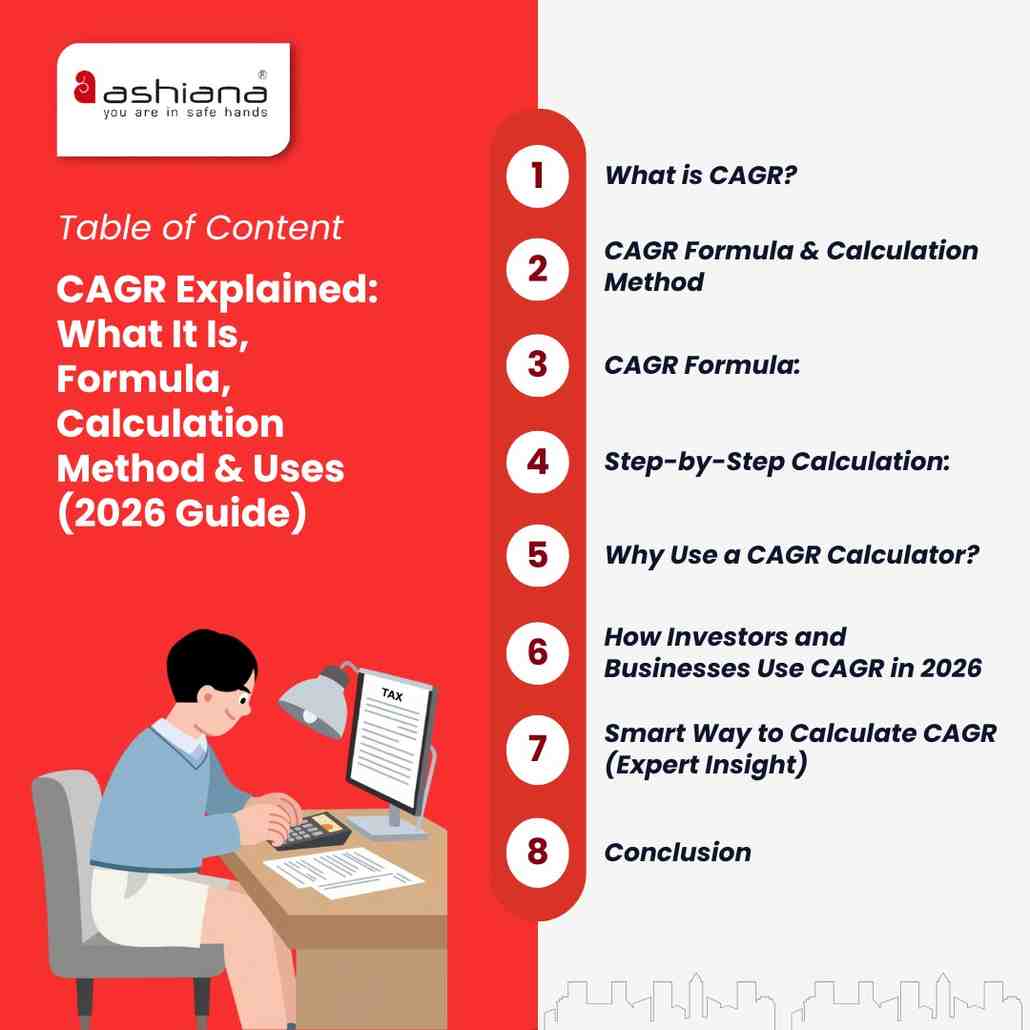
Before diving into tools and calculations, it’s important to understand what is CAGR.
Compound Annual Growth Rate (CAGR) is the rate at which an investment grows annually over a specific period, assuming profits are reinvested every year. It smooths out fluctuations and provides a consistent growth rate, making it easier to compare different investments.
In simple terms, CAGR answers this question:
“At what steady rate did my investment grow over time?”
If you’re wondering how to calculate CAGR, the formula is straightforward and widely used across finance and business analysis.
CAGR = (FV / PV)^(1/n) – 1
Where:
To simplify the process:
Let’s assume:
CAGR = (10,00,000 / 1,00,000)^(1/5) – 1 = 0.589 or 58.9% annually
This means the investment grew at an average annual rate of 58.9%, assuming the returns were compounded each year.
While manual calculations help build understanding, using a CAGR Calculator ensures speed and accuracy, especially when dealing with multiple datasets.
A CAGR calculator online is particularly useful for professionals who require quick insights without diving into complex formulas.
CAGR is not just a financial metric-it has wide applications across industries.
Investors use CAGR to compare:
Companies analyze CAGR to measure:
CAGR helps in:
Understanding the benefits will help you use CAGR more effectively:
Despite its usefulness, CAGR has certain limitations that must be considered:
For best results, CAGR should be used alongside other financial metrics such as ROI or IRR.
A common confusion arises between CAGR and simple growth rate.
| Metric | CAGR | Growth Rate |
| Nature | Compounded | Linear |
| Considers Volatility | No | Yes |
| Use Case | Long-term analysis | Short-term performance |
| Accuracy | More realistic | Less consistent |
CAGR is generally preferred for long-term analysis due to its ability to smooth fluctuations.
With the rise of data analytics and performance-driven strategies, CAGR continues to be a critical metric:
It serves as a reliable benchmark for evaluating performance across sectors.
While understanding the formula is essential, modern users increasingly rely on tools for efficiency. For example, Ashiana Housing’s CAGR Calculator provides a simple and effective way to evaluate growth across investments or real estate assets.
Such tools enable faster decision-making and eliminate the risk of manual calculation errors, making them highly valuable for both beginners and professionals.
In a data-driven world, understanding growth metrics like CAGR is essential for making informed decisions. From evaluating investments to tracking business performance, CAGR offers a clear and consistent way to measure long-term growth.
Using a reliable CAGR Calculator not only improves accuracy but also enhances efficiency, allowing you to focus on strategy rather than calculations. Whether you are an investor or a business professional, mastering CAGR can significantly strengthen your analytical capabilities in 2026 and beyond.
Disclaimer – This article is meant for general information and awareness only. The views shared here are those of the author and do not necessarily reflect the official views or policies of Ashiana Housing Limited or its affiliates. While efforts have been made to ensure the information is accurate, no assurance is given regarding its completeness or reliability. Any calculator results or explanations mentioned are indicative and should not be considered financial, legal, or investment advice. Readers are encouraged to consult qualified professionals before making any property or financial decisions based on this content.
Join 1000+ of fellow readers. Get expert real estate knowledge straight to your inbox absolutely free. Just enter your email address below.


Leave a Reply