Gratuity Calculator India 2026: How to Calculate Gratuity After the New Labour Code

Understanding your Retirement Benefits is essential for long-term financial planning, and gratuity is a key component of it. With evolving labour regulations, using a Gratuity Calculator helps you estimate your gratuity payout accurately and plan your finances better.


In India, gratuity is governed by the Payment of Gratuity Act, 1972, while tax treatment is defined under the Income-tax Act, 1961. With updated gratuity rules under the new labour codes, it is important to understand how gratuity is calculated in 2026.
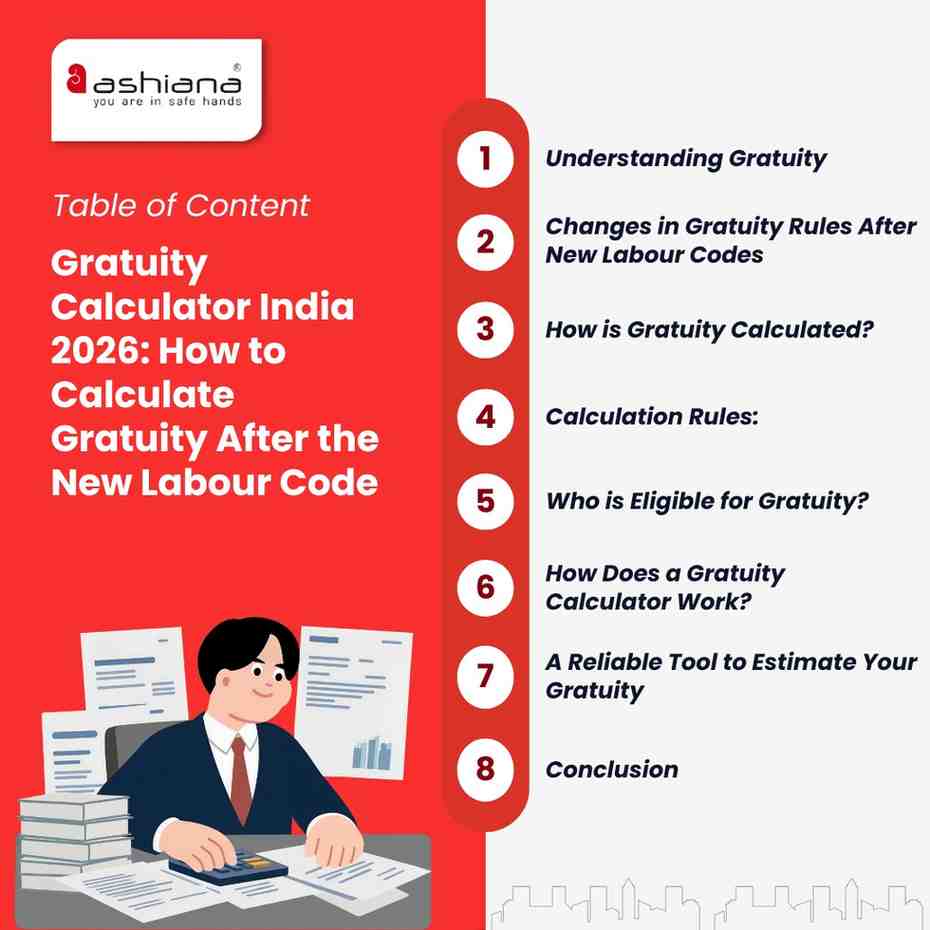


Gratuity Calculator India 2026: How to Calculate Gratuity After the New Labour Code


Understanding Gratuity


Gratuity is money your employer pays you as a token of appreciation for your years of service. It is typically paid:


  • Upon retirement
  • On resignation after completing the minimum qualifying period
  • On completion of a fixed-term employment contract
  • In case of death or disablement


The Payment of Gratuity Act, 1972, ensures that eligible employees receive this benefit as part of their financial security.


Changes in Gratuity Rules After New Labour Codes


The new labour codes have introduced important updates to existing gratuity rules in India.


Key Changes:


  • Eligibility for fixed-term employees without completing 5 years (subject to service conditions)
  • Expanded coverage of establishments
  • Revised wage definition where basic salary must be at least 50% of total remuneration


Gratuity continues to be calculated as per the Payment of Gratuity Act, 1972.


How is Gratuity Calculated?


1. When an Employee is Covered Under the Payment of Gratuity Act, 1972


Formula:


Gratuity = (15 / 26) × Last Drawn Monthly Wages × Completed Years of Service


Calculation Rules:


  • Last drawn wages include basic salary + dearness allowance
  • Monthly wages must be at least 50% of total remuneration
  • 26 represents working days in a month
  • Service exceeding 6 months is rounded up


Example:


  • Total monthly remuneration = ₹66,000
  • Eligible wages (50%) = ₹33,000
  • Service = 5 years 9 months → 6 years


Gratuity = (15 × 33,000 × 6) / 26 = ₹1,14,231 (approx.)


2. When an Employee is Not Covered Under the Payment of Gratuity Act, 1972


Formula:


Gratuity = (15 / 30) × Last Drawn Monthly Wages × Completed Years of Service


Calculation Rules:


  • Salary is considered as per company policy
  • Basic salary is assumed to be at least 50% of total remuneration
  • 30 days taken as a full month
  • No statutory rounding


Example:


  • Total monthly remuneration = ₹66,000
  • Basic salary = ₹33,000
  • Service = 6 years


Gratuity = (15 × 33,000 × 6) / 30 = ₹99,000


Who is Eligible for Gratuity?


Covered Under the Payment of Gratuity Act, 1972:


  • Employees in organizations with 10 or more employees
  • Minimum 5 years of continuous service
  • Fixed-term employees may qualify earlier


Not Covered:


  • Employees in small businesses
  • Contract roles depending on employer policy


When is Gratuity Paid?


As per the Payment of Gratuity Act, 1972, gratuity is paid:


  • On resignation or retirement
  • On completion of a fixed-term contract
  • Immediately in case of death or disability


Tax Benefits on Gratuity


Gratuity is taxed under the Income-tax Act, 1961.


Government Employees:


  • Fully exempt under Section 10(10)(i)


Private Sector Employees Covered Under the Payment of Gratuity Act, 1972:


  • Exempt under Section 10(10)(ii)


Employees Not Covered:


Exemption is the least of:


  • Actual gratuity received
  • ₹20,00,000 limit
  • Half a month’s average salary × years of service


Applicable under Section 10(10)(iii) of the Income-tax Act, 1961.


How Does a Gratuity Calculator Work?


A Gratuity Calculator helps you estimate your gratuity instantly.


You need to enter:


  • Employment duration
  • Last drawn salary
  • Coverage under the Payment of Gratuity Act, 1972
  • Type of employment


The calculator:


  • Applies the correct formula
  • Calculates years of service
  • Estimates gratuity amount
  • Shows tax implications under the Income-tax Act, 1961


A Reliable Tool to Estimate Your Gratuity


If you are looking for a dependable platform to calculate gratuity, the Ashiana Housing Gratuity Calculator offers a simple and user-friendly solution. It allows users to enter their salary and years of service to instantly estimate their potential gratuity payout.


Such tools are especially useful for professionals reviewing their retirement benefits or planning career transitions. Instead of relying on manual calculations, users can get quick and accurate insights into their expected financial outcomes.


Conclusion


Gratuity is an essential part of your Retirement Benefits, governed by the Payment of Gratuity Act, 1972, with tax treatment defined under the Income-tax Act, 1961. With evolving gratuity rules, understanding their calculation is crucial for financial planning.


Using a reliable Gratuity Calculator ensures accurate estimation and helps you make informed financial decisions for the future.


Disclaimer – This article is meant for general information and awareness only. The views shared here are those of the author and do not necessarily reflect the official views or policies of Ashiana Housing Limited or its affiliates. While efforts have been made to ensure the information is accurate, no assurance is given regarding its completeness or reliability. Any calculator results or explanations mentioned are indicative and should not be considered financial, legal, or investment advice. Readers are encouraged to consult qualified professionals before making any property or financial decisions based on this content.


Don't forget to share this valuable article with others

About The Author

admin,

Other posts by

Free

Subscribe Now to our blog. Stay up to date with the latest real estate market, investment option, updates on senior living & kid centric world & Just enter your email address to subscribe

Join 1000+ of fellow readers. Get expert real estate knowledge straight to your inbox absolutely free. Just enter your email address below.

Get our blogs straight in your inbox,
know real estate better:
[email-subscribers-form id="2"]

wait your request is under process

Site Visit

wait your request is under process