

Home loans are not just a pathway to fulfilling your dream of homeownership—they also come with significant tax-saving benefits. With the Budget 2025 introducing certain amendments, understanding home loan deductions is crucial for optimizing your financial planning. In this blog, we break down the tax benefits of home loans and explore how the latest budget impacts these deductions.
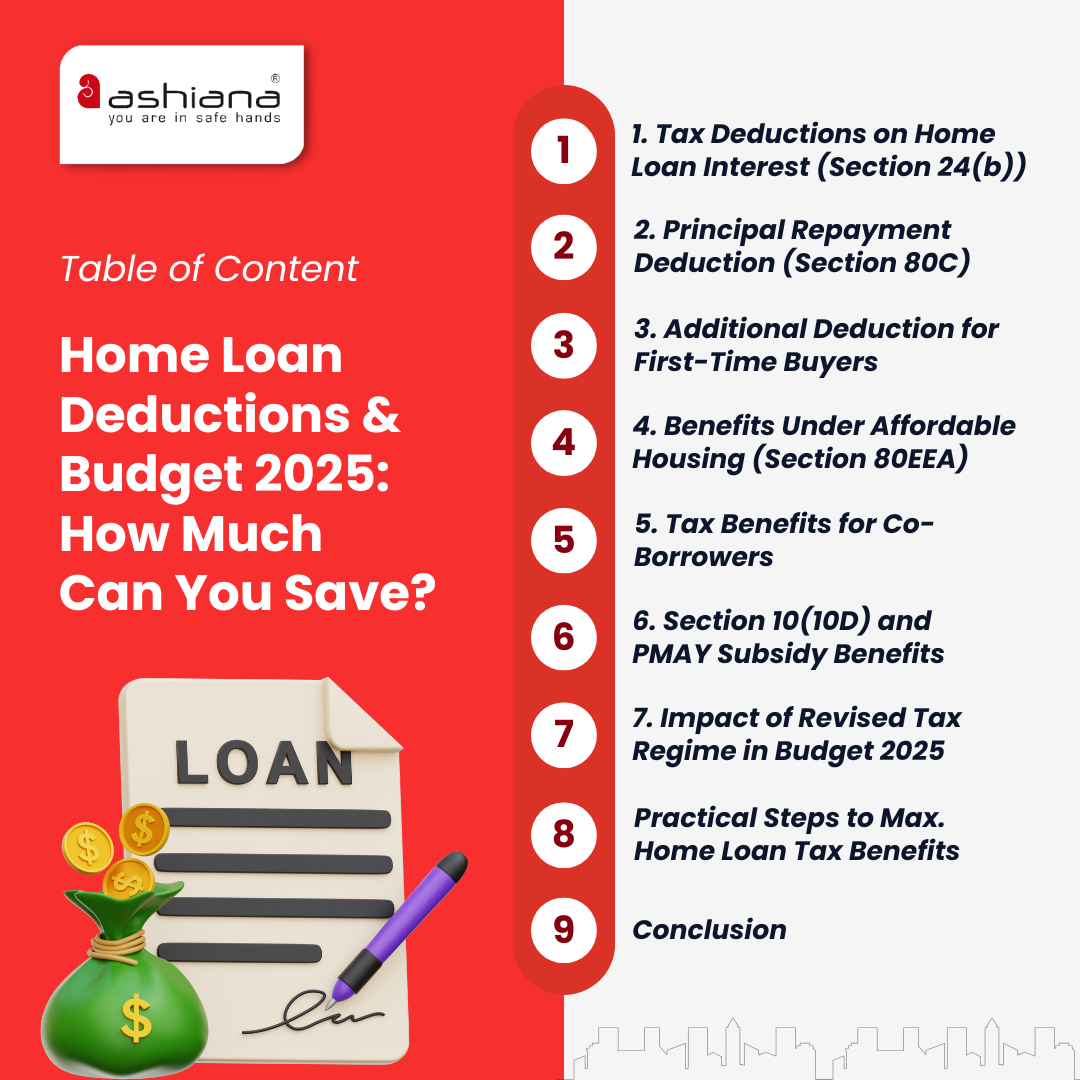
Under Section 24(b) of the Income Tax Act, home loan borrowers can claim deductions on the interest paid for the loan:
Budget 2025 Update: No major changes were announced under Section 24(b), ensuring the ₹2 lakh limit remains intact for self-occupied homes.
The principal amount repaid during a financial year is eligible for deduction under Section 80C, with a combined limit of ₹1.5 lakh. This deduction is applicable only if the property is not sold within five years of possession; otherwise, the benefits are reversed.
Pro Tip: Combine this with other 80C investments, such as ELSS, PPF, and life insurance premiums, to maximize the benefits.
Section 80EE offers an additional deduction of up to ₹50,000 on home loan interest payments to encourage first-time homebuyers. The eligibility criteria are:
Budget 2025 Impact: The cap remains unchanged, continuing to benefit first-time buyers with modest property purchases.
Ref: https://www.ujjivansfb.in/banking-blogs/borrow/home-loan-tax-benefits
For affordable housing buyers, Section 80EEA provides an additional deduction of up to ₹1.5 lakh on interest payments. This is over and above the ₹2 lakh allowed under Section 24(b). To qualify:
Budget 2025 Extension: The government extended the deadline for availing of Section 80EEA benefits until March 31, 2026, giving affordable housing buyers more time to claim additional deductions.
If the home loan is jointly held, each co-borrower can claim deductions individually under Sections 24(b), 80C, 80EE, and 80EEA, provided they are also co-owners of the property. This can significantly enhance the overall tax savings for families with multiple taxpayers.
Example: If a couple jointly holds a loan and pays ₹4 lakh as interest, both can claim ₹2 lakh each under Section 24(b), doubling the tax benefits.
Also read: Falling Under the Tax Bracket? Here’s How to Invest in Real Estate in 2025
The Pradhan Mantri Awas Yojana (PMAY) offers a credit-linked subsidy scheme (CLSS) for first-time buyers in specific income groups. The subsidy reduces the upfront principal loan amount, thereby indirectly lowering tax liability.
While the Budget 2025 did not announce new subsidies, the existing benefits under the PMAY Urban and Rural schemes continue to aid eligible beneficiaries.
The new tax regime introduced in Budget 2020 does not allow exemptions or deductions, including those on home loans. However, the Budget 2025 raised the standard deduction under the new regime to ₹50,000, making it slightly more competitive.
For taxpayers benefiting significantly from home loan deductions, the old tax regime often remains more advantageous. Assess your tax liability under both regimes to decide what works best for you.
Also read: Is 2025 the Best Year to Buy Property? Budget Announcements That Favor Homebuyers
Home loans remain a cornerstone of financial planning, offering substantial tax savings and easing the path to homeownership. The Budget 2025 has sustained most of the existing benefits while extending provisions like Section 80EEA for affordable housing.
Understanding and strategically utilizing these deductions can significantly reduce your tax outgo while investing in your dream home. Whether you’re a first-time buyer or upgrading to a better property, ensure you’re leveraging all available benefits to save more in the long run.
Take advantage of these opportunities, and let your home loan not just fulfill your housing needs but also work as a financial tool to secure a brighter future.
Join 1000+ of fellow readers. Get expert real estate knowledge straight to your inbox absolutely free. Just enter your email address below.


Leave a Reply